How accessible are libraries: cooperation exists, adaptations lag behind
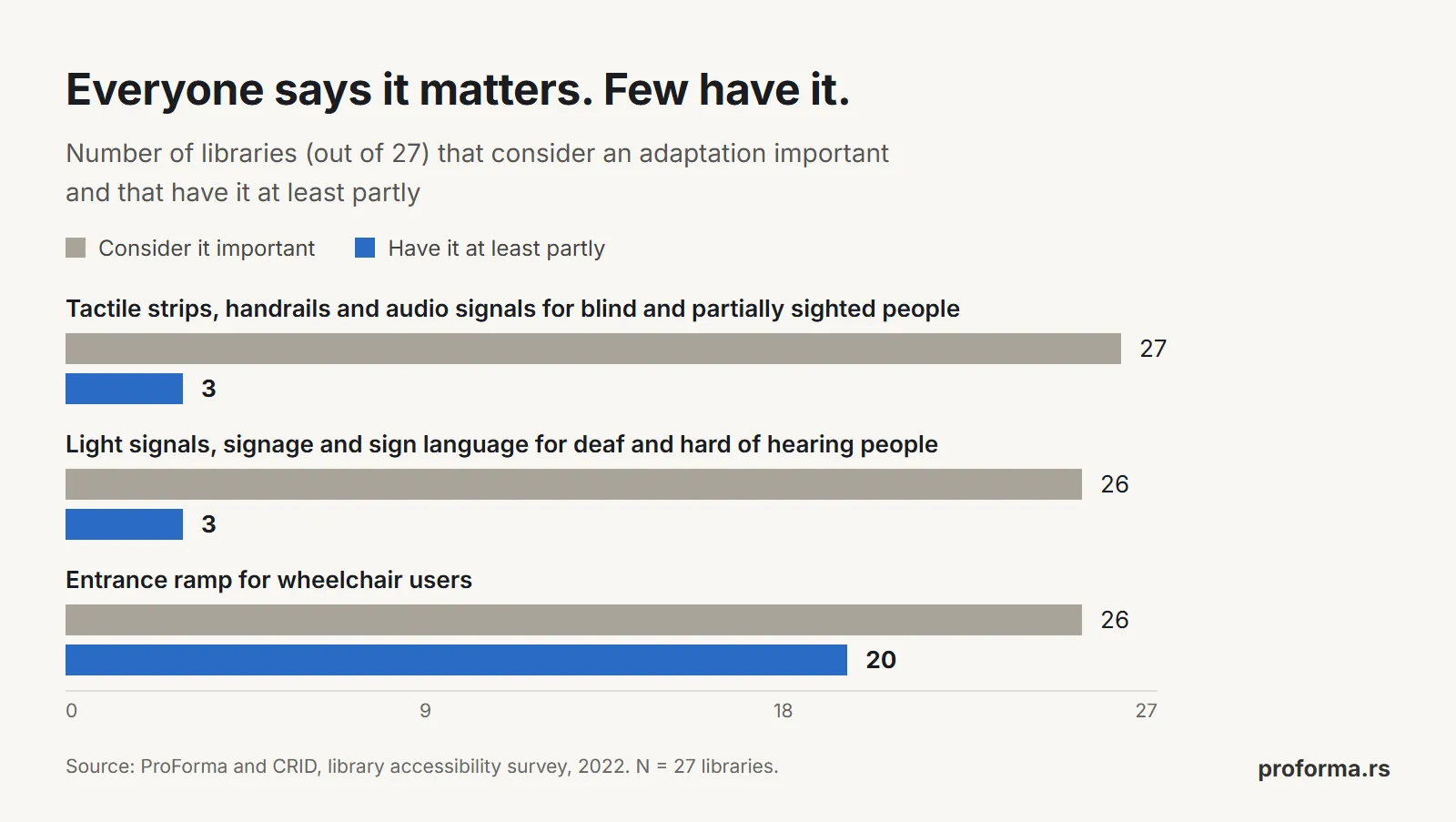
Every library in the survey considers tactile strips and audio signals for blind people important. Three out of twenty-seven have them. This is one of the findings of a survey ProForma carried out in 2022 with the Centre for the Development of an Inclusive Society (CRID).

The survey covered 27 public libraries. We asked them about their premises, equipment, software, alternative formats, websites, staff training and cooperation with persons with disabilities. It was carried out with the Centre for the Development of an Inclusive Society (CRID) to prepare workshops for library staff. Based on the results, we ran a series of some twenty workshops in libraries across Serbia, accredited by the National Library of Serbia as part of the continuing professional development programme for librarians.
The link with the community exists
We start with the good news. As many as 23 libraries (85%) cooperate with organisations of persons with disabilities, and 22 (81%) regularly send them information about their work. The ten libraries that gave figures reach a total of 759 people this way.
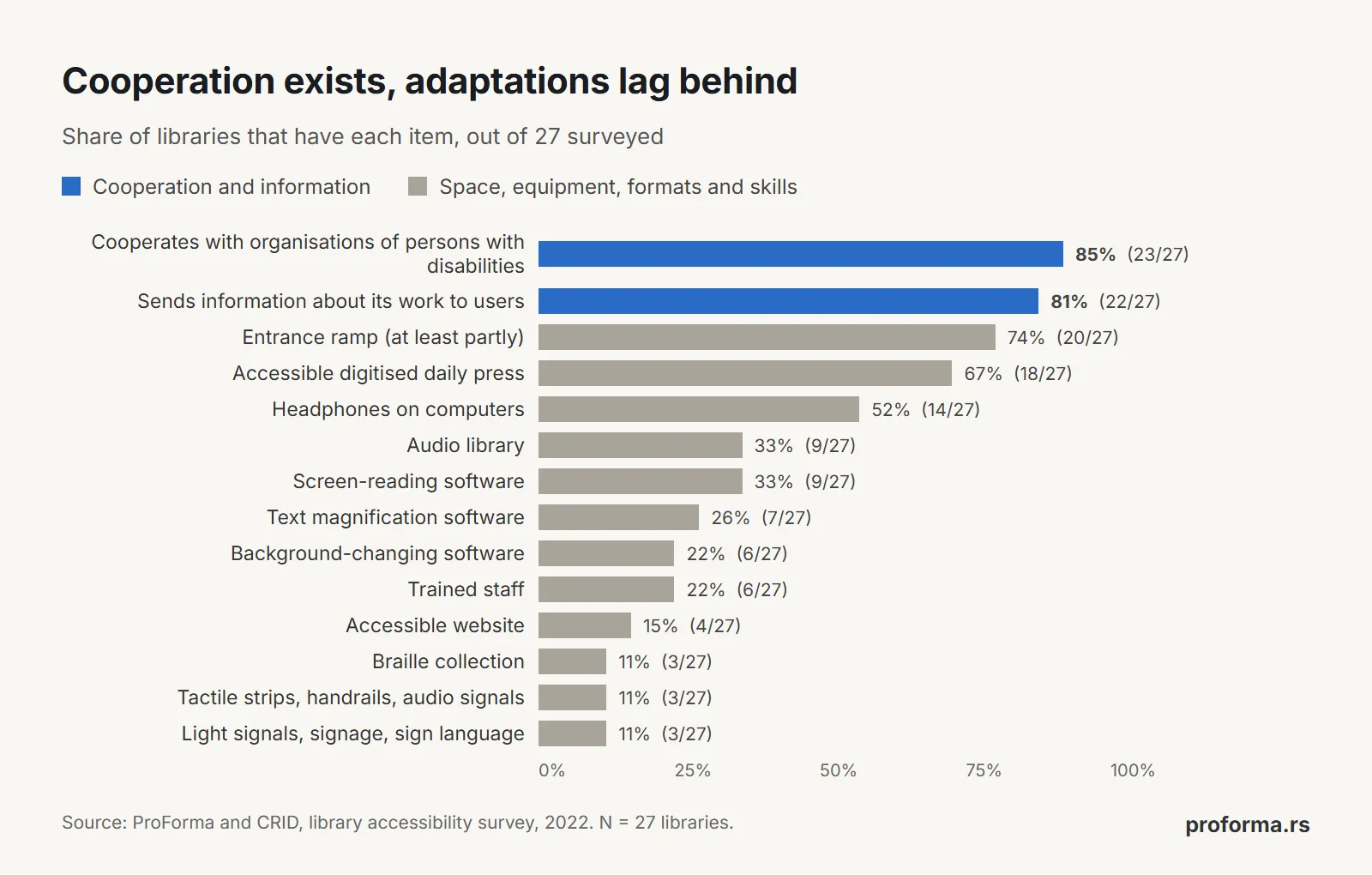
Once we move from information to adapting premises, equipment and collections, the numbers drop sharply.
Important, but missing
Libraries know what is needed. All 27 consider tactile strips, handrails and audio signals important, yet only 3 have them, even partly. Light signals, signage and sign language for deaf and hard of hearing people are considered important by 26 libraries, and again only 3 have them. The ramp is the exception: 20 libraries have one, at least partly.
Plenty of computers, fewer tools
The libraries surveyed have 374 computers in total. Screen-reading software is available in 9 libraries, text magnification in 7 and background-changing software in 6. Only 4 libraries (15%) have an accessible website, and 3 (11%) have a Braille collection.
Nine libraries have an audio library, with 690 titles in total. Most are on CD, and only one is in DAISY, the format designed for blind readers.
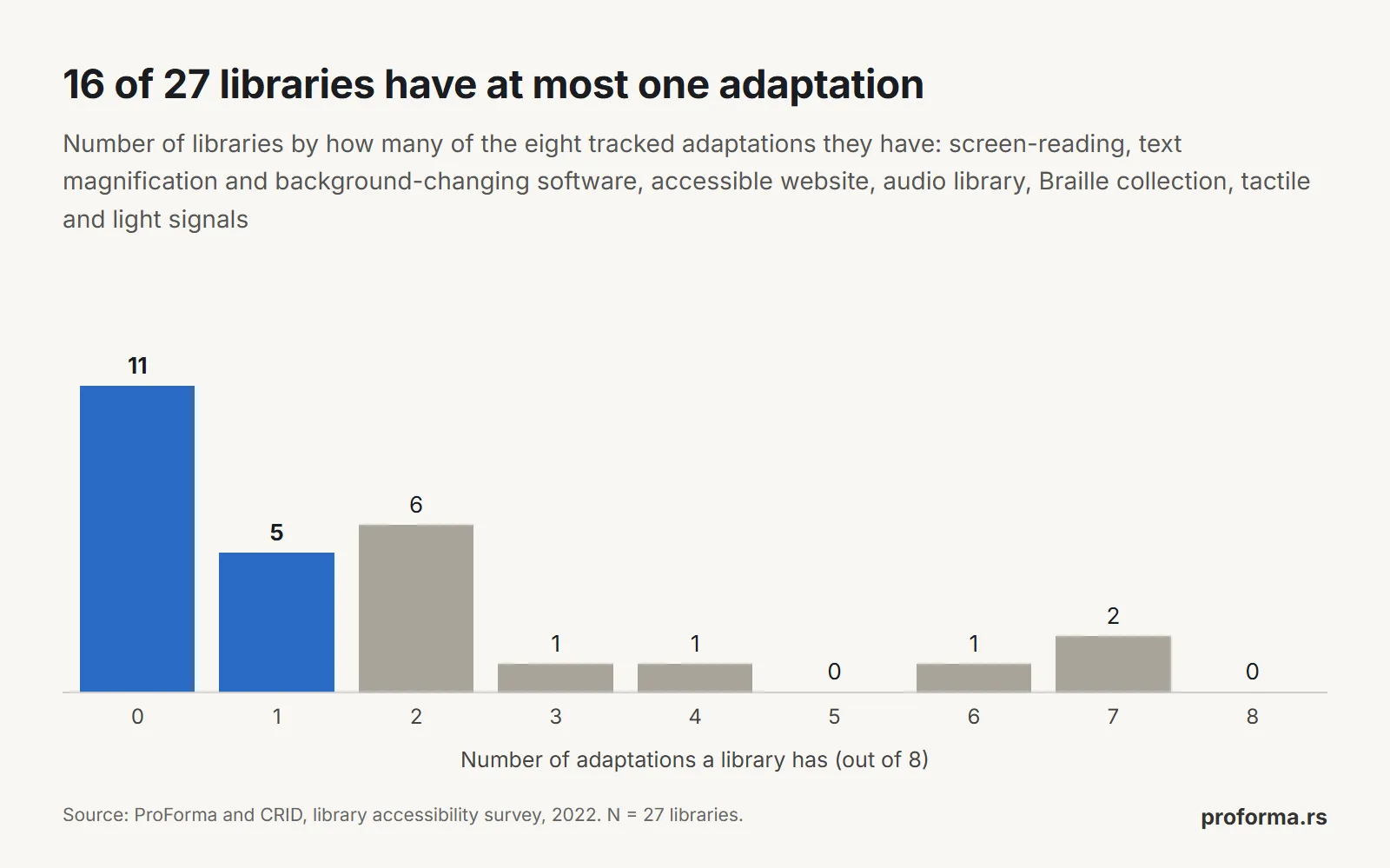
Adding up the eight adaptations we tracked, the picture is clear: 16 of the 27 libraries have at most one, and 11 have none.
Training makes a difference
Only 6 libraries (22%) have trained staff. On average, these libraries have 4.3 of the eight adaptations, while the others have 0.9. All four accessible websites belong to libraries with trained staff.
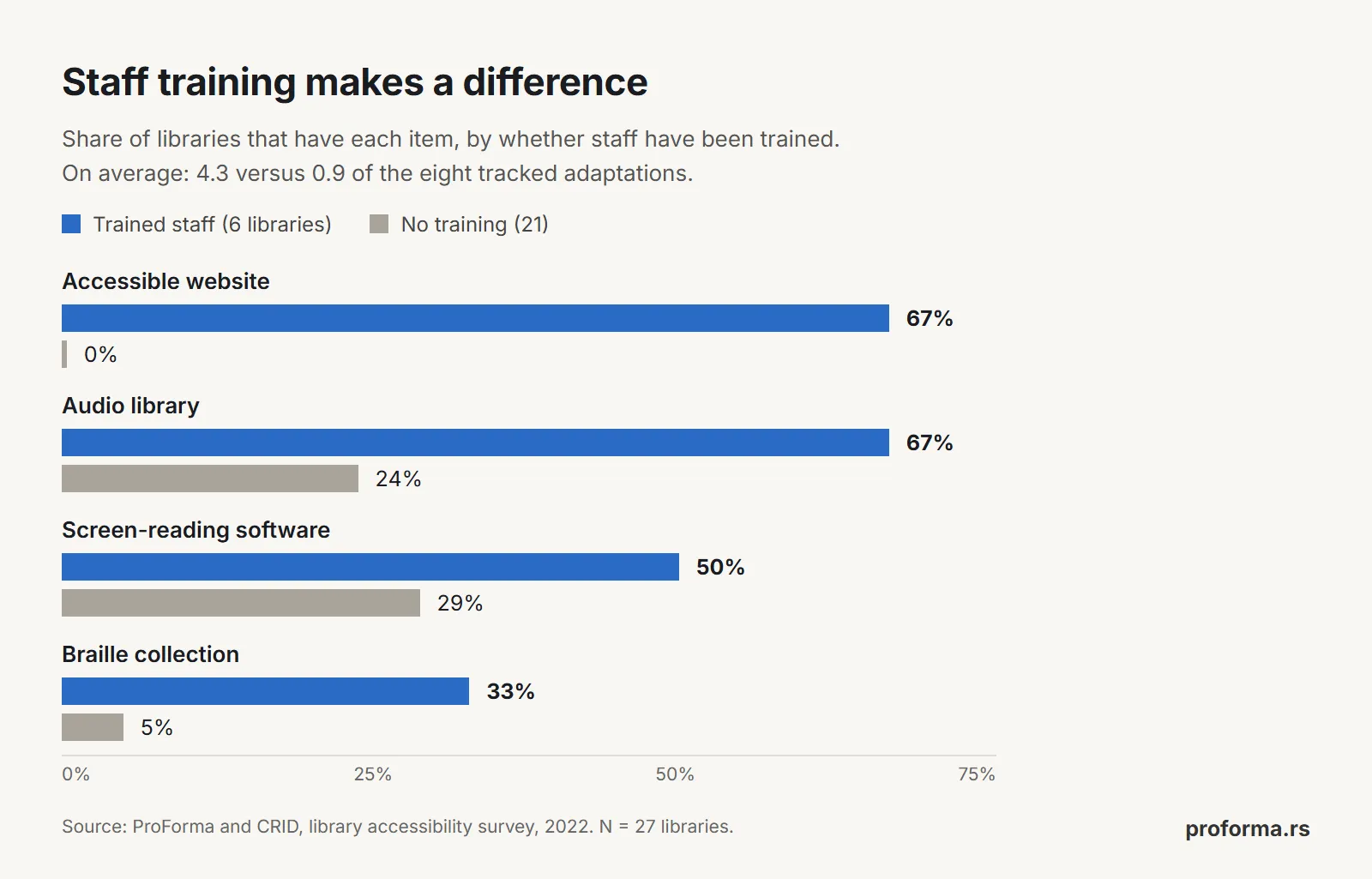
The sample is small and this is not proof of causation. Still, the direction is clear: where staff know whom they are adapting the service for and how, there are more adaptations. That is why training was at the heart of our workshops, and it is also the subject of the guide “Training for equality” from the “Culture of Equality” series.
What follows from this
- Training for all staff, not only those at the counter.
- Checking the website and premises against current accessibility standards, as a first step before any investment.
- Cooperation with organisations as a resource: the link already exists and can be used for consultation and testing.
The data describe the situation in 2022 and are based on the libraries’ own answers. If you would like a workshop for your team or to cooperate in this field, write to us at info@proforma.rs.
The workshops were accredited by the National Library of Serbia’s Decision on the accreditation of continuing professional development programmes in library and information work for 2022, no. 0101 1352/1 of 16 December 2021.